MAHA/Innovations/Iso Check EV
E-mobility & high voltage
High-voltage safety testing for EVs and charging infrastructure
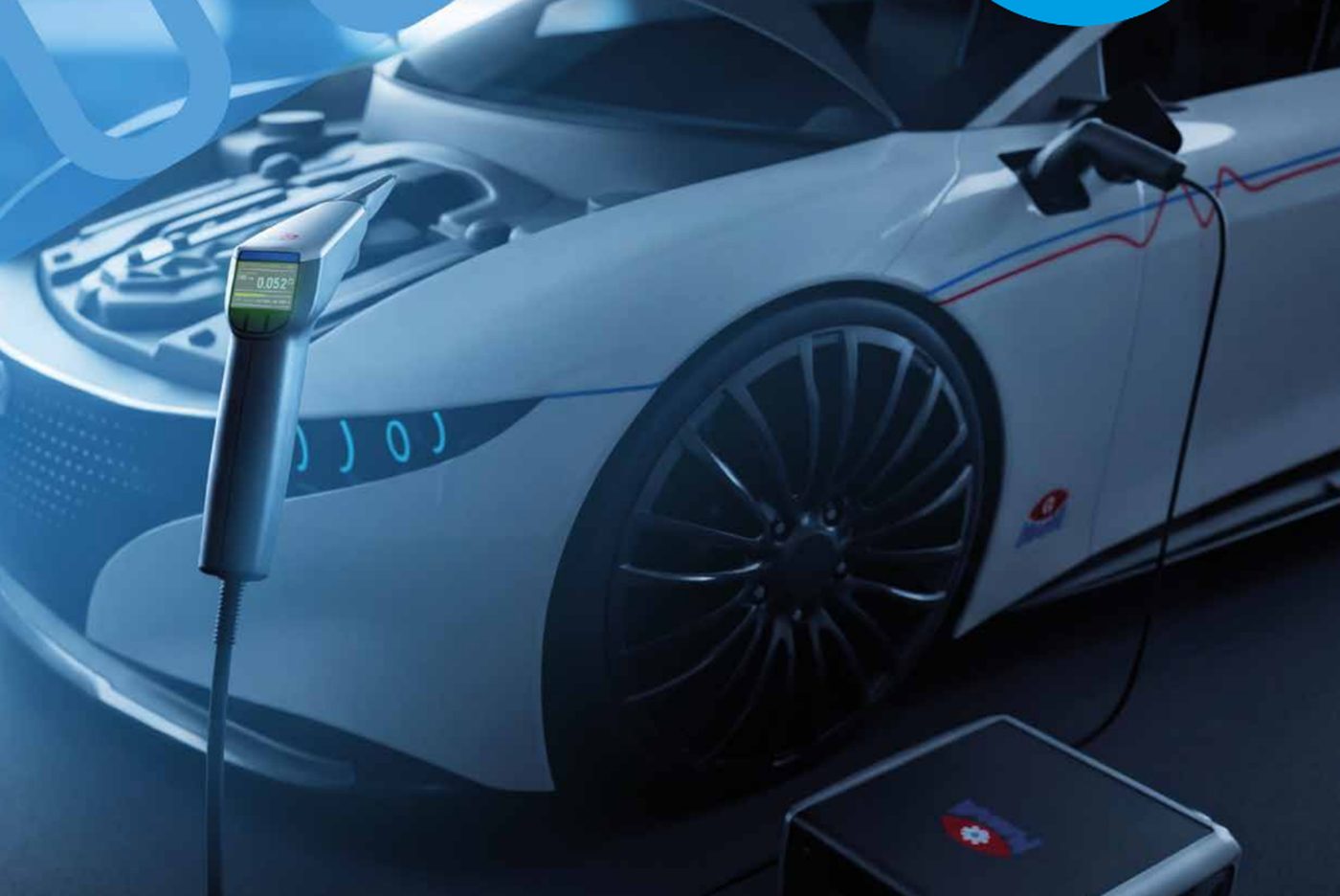
Three compliance checks, one device: Iso Check EV tests vehicle, charging cable and charging point in compliance with standards and guides the user step by step through every test path.
Concept phaseAnyone servicing an EV has to prove compliance with standards across several separate testing areas: insulation resistance and equipotential bonding on the vehicle, the charging cable as portable electrical equipment, and the on-site charging point. Until now, that has meant several test meters from various manufacturers, multiple user interfaces, different calibration cycles — and test records scattered across all of them.
Insulation resistance at the AC charging connector with a test voltage of 250 V, N, L1, L2, L3 against PE, automated. Optionally, insulation resistance on the HV/DC side with up to 1,000 V for 400 V and 800 V architectures. Low-resistance equipotential bonding measurement with test current > 250 mA and 4-wire/Kelvin test probe (all UN ECE R100).
Protective earth conductor, insulation, PP coding and fault simulation to VDE 0701/0702, DGUV V3 and EN 62752.
Protective earth conductor, insulation resistance, loop impedance, RCD, phase rotation and CP/PWM signal analysis to DIN VDE 0100-600/-722 and IEC 61851-1.
One file format covers all test paths. Reports are exported via USB or Bluetooth and archived in an audit-proof format. The display guides you through every test path one step at a time — operable by any technician qualified for HV work. The built-in storage and carry case gets the device up and running fast on site.
The innovations shown are at different stages of development. They are not available at short notice and will not necessarily be implemented in the version shown at the trade fair.
Product management and sales can provide information on availability, configuration and requirements for use.